
Ventilated Balance Enclosure
Flow Sciences Ventilated Balance Enclosures (VBE) provide personnel protection and containment for laboratory weighing, sampling, and benchtop processing of Active Pharmaceutical Ingredients (APIs), hazardous powders, and other toxic compounds. Third-party surrogate powder testing has validated exposure levels below 1 μg/m³, based on process and quantity. The enclosure is available in single-HEPA and dual-HEPA configurations and is designed to meet USP <800> hazardous drug compounding requirements.
What Is a Ventilated Balance Enclosure?
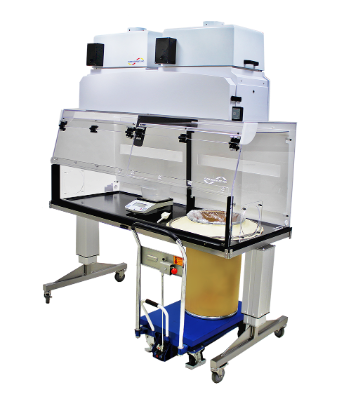
A ventilated balance enclosure is a laboratory safety cabinet engineered to capture airborne particulates generated during weighing and powder-handling operations. The Flow Sciences VBE uses internal plenums and strategically positioned aerodynamic airfoils around the face opening to produce smooth, horizontal laminar airflow across the work surface. This airflow pattern reduces turbulence, protects sensitive balances from vibration-induced error, and prevents user exposure to hazardous particulates. The exhaust system, mounted at the top of the unit, can recirculate filtered air back into the room or connect to house exhaust, depending on the hazard classification of the materials being processed.
Applications and Compatible Equipment
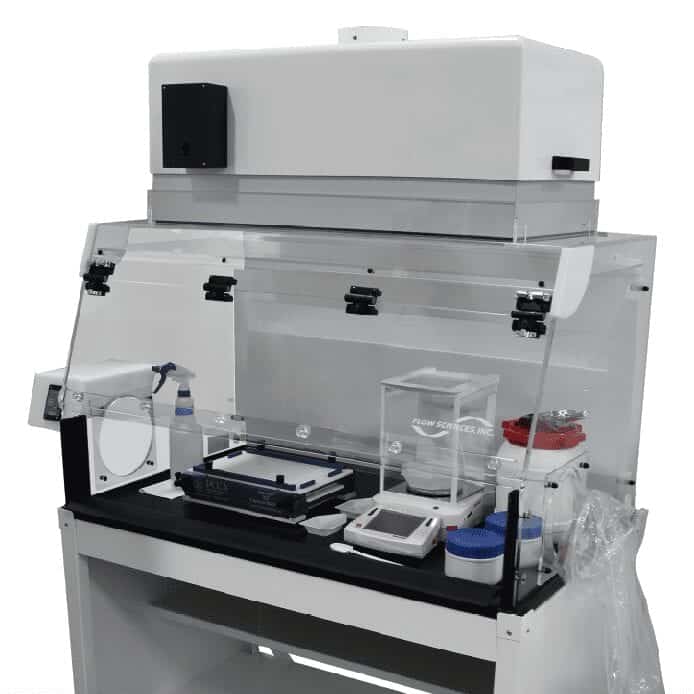
The Flow Sciences Ventilated Balance Enclosure accommodates a broad range of laboratory instruments and processes within its 30-inch-deep work surface, including:
- Analytical and precision balances for API and hazardous powder weighing
- FTIR spectrometers and other benchtop analytical instruments
- Sieves, ovens, and dispensing equipment for pharmaceutical and chemical processing
- Nanotechnology sample preparation and containment
- Hazardous drug (HD) handling in compounding pharmacy environments requiring USP <800> compliance
Available Configurations
Dual-HEPA Ventilated Balance Enclosure — Hazardous, Non-Sterile Applications
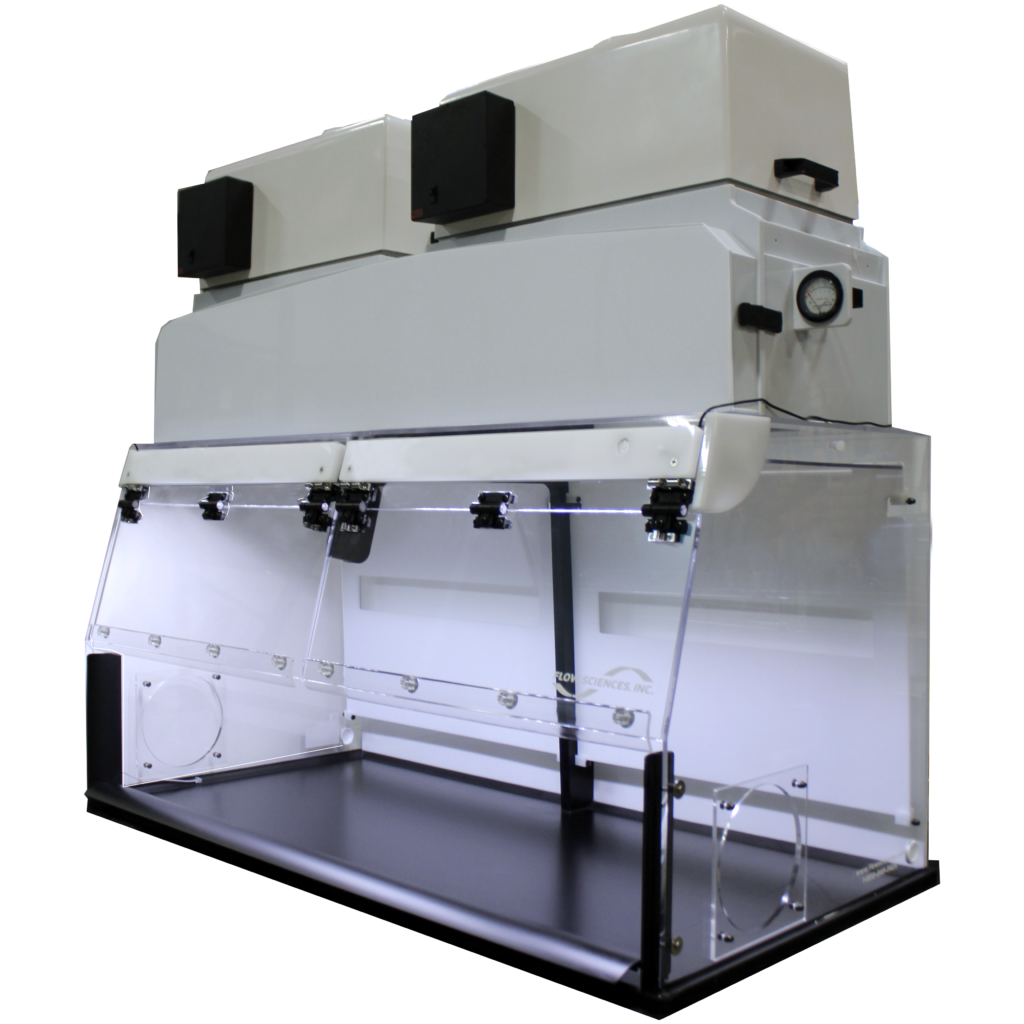
The Flow Sciences dual-HEPA Ventilated Balance Enclosure contains two 4-inch HEPA filters and an integrated fan unit positioned at the top of the cabinet. This configuration allows the unit to recirculate filtered air back into the laboratory, eliminating the need for a dedicated house exhaust connection and reducing facility conditioning costs. A thimble connection and vent kit are available as optional accessories for redundant exhaust. This model is designed for laboratories handling hazardous, non-sterile compounds where HEPA filtration alone provides sufficient protection, and it is the recommended configuration for USP <800> hazardous drug compounding compliance.
Single-HEPA Ventilated Balance Enclosure — Non-Hazardous, Non-Sterile Applications
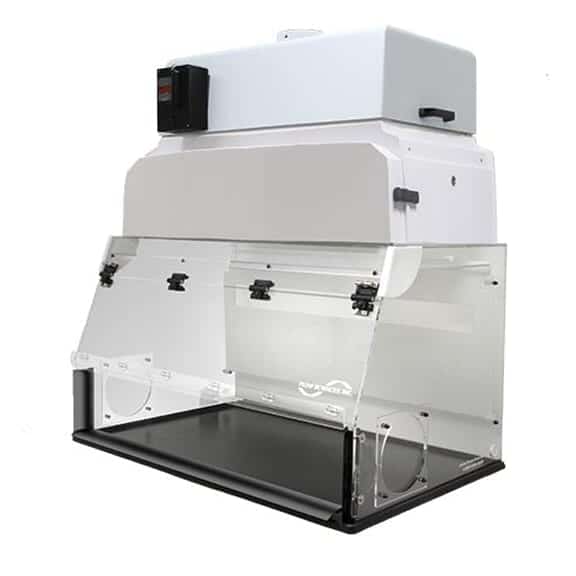
The Flow Sciences single-HEPA Ventilated Balance Enclosure contains one 4-inch HEPA filter and an integrated fan. This configuration requires a thimble connection and vent kit to connect to the facility’s house exhaust system. It is designed for laboratories handling non-hazardous or lower-toxicity powders where personnel protection and reproducibility during sensitive weighing operations are the primary requirements.
Key Technical Benefits
| Benefit | Specification / Detail |
|---|---|
| Validated Containment | Third-party surrogate powder testing confirms exposure levels below 1 μg/m³, based on process and quantity. Performance data available for compliance documentation. |
| Vibration Isolation | Fan assembly is mechanically isolated from the work surface, eliminating vibration-induced weighing errors on analytical balances. |
| Stable Laminar Airflow | Internal plenums and aerodynamic airfoils at the face opening produce horizontal laminar airflow that minimizes turbulence and material loss. |
| USP <800> Compliance | Dual-HEPA configuration supports USP <800> requirements for hazardous drug handling in compounding pharmacy and pharmaceutical laboratory settings. |
| Flexible Exhaust Options | Dual-HEPA units recirculate into the lab; single-HEPA units connect to house exhaust via thimble connection. Both options available with optional vent kit. |
| Filter Life and Energy Savings | HEPA filters rated for 4–5 years of service life. Recirculating dual-HEPA configuration reduces make-up air demand and facility HVAC energy costs. |
| Chemical-Resistant Construction | Phenolic work surface resists spills and chemical exposure. Acrylic side panels provide high light transmission and clear visibility into the work area. |
| Face Velocity Monitoring | Optional face velocity alarm provides visual and audible notification of airflow disruptions, supporting continuous safety compliance monitoring. |
| ISO 9001:2015 Certified Manufacturing | Every Flow Sciences Ventilated Balance Enclosure is manufactured under an ISO 9001:2015-certified quality management system with factory acceptance testing (FAT) in accordance with ASHRAE 110-2016. |
Regulatory Compliance and Testing Standards
Flow Sciences Ventilated Balance Enclosures are designed and tested to the following standards:
- ASHRAE 110-2016: Factory acceptance testing (FAT) performed in Flow Sciences’ in-house test laboratory
- USP <800>: Dual-HEPA configuration supports compliance for hazardous drug handling in non-sterile compounding environments
- OSHA hazardous materials handling requirements: Containment performance supports compliance documentation for industrial hygiene programs
- ISO 9001:2015: All units manufactured under a certified quality management system ensuring reproducible performance
Surrogate powder testing data and FAT documentation are available to support internal safety assessments, regulatory audits, and capital equipment justification to management.
Frequently Asked Questions
What is the difference between a ventilated balance enclosure and a fume hood?
A ventilated balance enclosure is specifically engineered for precision weighing and powder-handling tasks where airflow stability and vibration isolation are critical. Unlike a conventional chemical fume hood, the Flow Sciences VBE uses internal plenums and airfoils to create smooth horizontal laminar airflow that prevents balance interference and minimizes material loss. Fume hoods are designed primarily for chemical vapor control and are not optimized for the low-turbulence airflow required for accurate powder weighing.
Does the ventilated balance enclosure require a connection to building exhaust?
The dual-HEPA Ventilated Balance Enclosure can operate as a fully recirculating unit without a building exhaust connection, which provides flexibility in laboratory placement and reduces installation costs. The single-HEPA configuration requires a thimble connection to the facility house exhaust system. Both models are available with an optional vent kit for added redundancy.
What OEL (Occupational Exposure Limit) levels can this enclosure contain?
Containment performance is dependent on the potency, quantity, and specific process being performed. Third-party surrogate powder testing has validated exposure levels below 1 μg/m³ for standard weighing processes. Flow Sciences’ engineering team can work with customers to assess OEL requirements and recommend the appropriate containment solution for specific compounds and processes.
How long do the HEPA filters last, and what does replacement involve?
Flow Sciences HEPA filters are rated for 4–5 years of service life under normal operating conditions, significantly reducing long-term maintenance costs compared to shorter-life alternatives. Filter replacement is performed using a bag-in/bag-out (BIBO) procedure on dual-HEPA configurations, protecting maintenance personnel from contaminated filter media during changeout.
Discuss Your Containment Requirements with a Flow Sciences Engineer
Flow Sciences engineers work directly with safety advocates, process engineers, and engineering leaders to specify Ventilated Balance Enclosures that integrate with existing workflows, meet OEL requirements, and satisfy regulatory documentation needs. Contact Flow Sciences to discuss your application, request surrogate powder testing data, or initiate a custom containment design.